The Agency of the Holy Spirit — and the Danger of Restoring Rome’s Doctrines
To dig up and restore the doctrines of Rome—cast off by the original Adventist pioneers between 1841 and 1850—is to reject the Spirit of Christ and to commit the very blasphemy warned of in Scripture. The Comforter is the Spirit of Christ Himself, not a separate being or a papal invention. The pioneers were explicit:
"Here we might mention the Trinity, which does away the personality of God, and of his Son Jesus Christ, and of sprinkling or pouring instead of being 'buried with him by baptism,' and of the change of the Sabbath, et cetera. We call these the inventions of men." — James White, Review & Herald, December 11, 1855
"The SUNDAY is purely a Papal institution, and its observance was never sanctioned by Sacred Scripture. It rests wholly upon the authority of the Papacy." — James White, Review & Herald, April 4, 1854
"The Reformation was never completed. The reformers stopped reforming. The Sabbath, the Sanctuary, the nature of man, and the non-immortality of the soul, are truths which the reformers did not reach. The last message of mercy is to complete the work of reform." — James White, Review & Herald, February 7, 1856
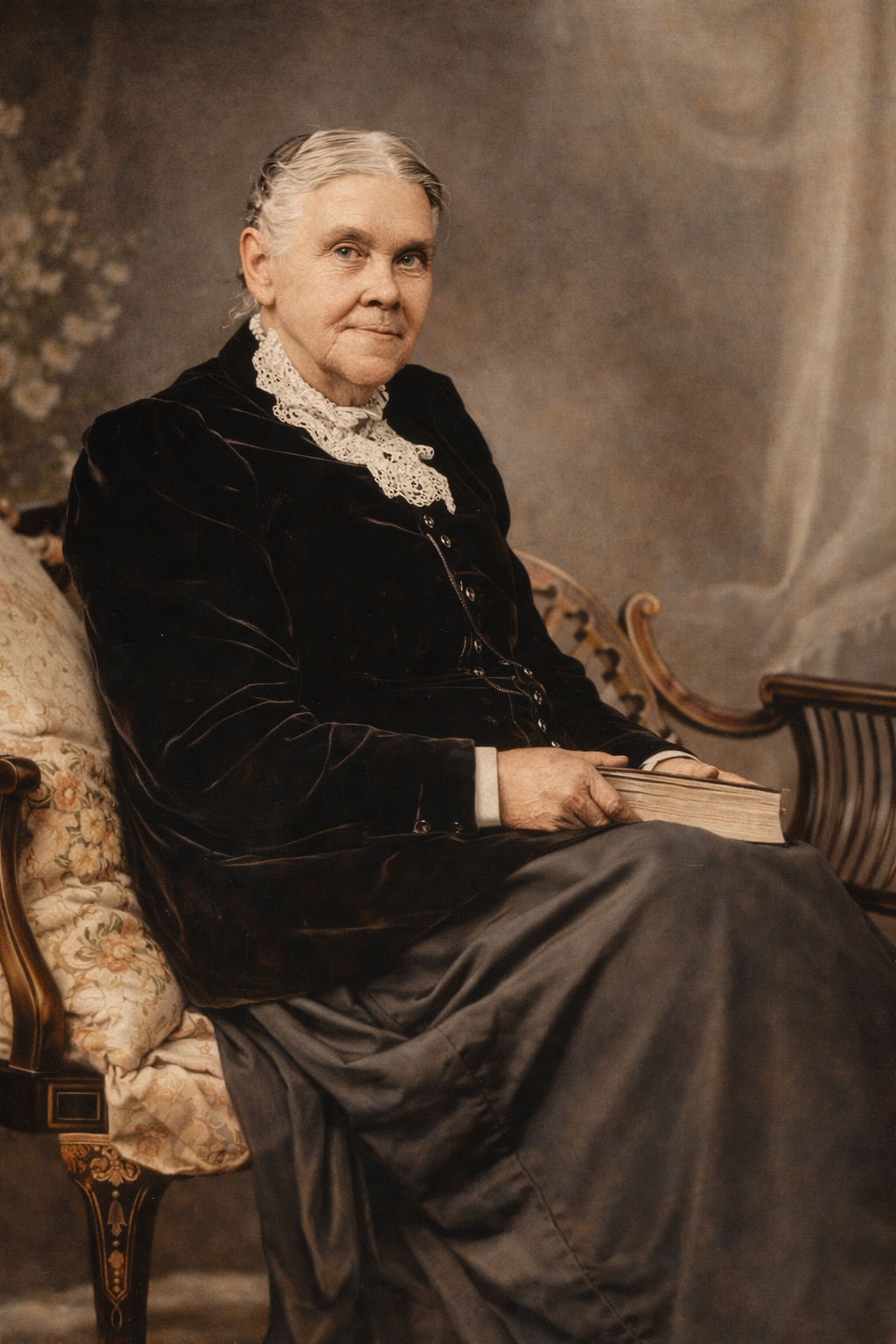
Ellen White is easiest to flatten into a symbol. The truer way to read her is to begin where she began: not with institutions, not with controversies, not with the weight of later history, but with a girl from Maine who carried pain, fear, earnest faith, and a very plain longing to belong wholly to Christ.
Her Early Years In Her Own Strain Of Speech
Ellen Gould Harmon was born in Gorham, Maine, in 1827, and while still young her family moved to Portland.
One childhood injury marked the whole texture of her early life. At nine years old she was struck in the face by a stone, an accident she later remembered not only for the suffering it caused but for the inward turning it forced upon her.
Looking back, she wrote words that tell you immediately how she understood her own story: “This misfortune, which for a time seemed so bitter and was so hard to bear, has proved to be a blessing in disguise.”
That sentence sounds like her. She does not deny the wound. She reads providence through it.
“This misfortune, which for a time seemed so bitter and was so hard to bear, has proved to be a blessing in disguise.”
In Portland, under the influence of Methodist piety and then the Millerite revival, her conscience awakened early and intensely.
She did not describe those years with the detached tone of a later historian. She described them as someone who had trembled through them.
In Life Sketches she recalled William Miller's meetings with unusual vividness: “Mr. Miller traced down the prophecies with an exactness that struck conviction to the hearts of his hearers.”
She was not a spectator in those meetings. She was a searching, sensitive listener, trying to find peace with God.
That is one reason the best Ellen White biography cannot sound merely encyclopedic. In her own telling, the drama of her youth was interior before it was public.
She feared being lost. She prayed much. She wrestled her way toward assurance.
When peace finally came, she remembered that season almost as sunlight after a storm. The emotional temperature of her writing matters.
It is what makes her early life readable not as denominational origin-story alone, but as conversion narrative.
After The Great Disappointment
The Great Disappointment of October 1844 did not hit Ellen as a theory failing on paper. It struck her generation at the level of hope, shame, and public humiliation.
Many stepped away. Ellen did not.
In December 1844, while praying with a small group of women in Portland, she experienced the first vision that made her name impossible to keep private. She later described that moment in language at once simple and elevated:
“While praying, the power of God came upon me as I never had felt it before, and I was wrapt up in a vision of God's glory.”
That first vision did not arrive as self-promotion. In her own recollections, she was reluctant, shrinking, and fully aware of how exposed such a claim would make her.
But from that point onward, she understood her life as claimed for service.
The shy girl would become a public voice, though never in the manner of a platform celebrity.
Even when she spoke forcefully, there remained in her prose the moral earnestness of someone who believed she had first been broken, searched, and corrected by God before she dared speak to anyone else.
The Second Angel’s Message, the 1850 Chart, and the Pioneers
Ellen White’s entire prophetic ministry was grounded in the Second Angel’s Message—a warning against the union of church and state, and a call to come out of spiritual Babylon. She, along with the early Adventist pioneers, identified the formation of church-state corporations as the very image of the beast and the fulfillment of the second angel’s warning.
The 1850 Prophecy Chart—produced with the direct involvement of Otis Nichols and Mary Bird Nichols—was the only chart Ellen White ever explicitly endorsed as being “directed by the hand of the Lord.” This chart visually set forth the three angels’ messages, including the second angel’s call to come out of Babylon. See the chart and its context: 1850 Prophecy Chart.
Key Pioneers:
- Otis Nichols & Mary Bird Nichols — printers and defenders of the 1850 chart and the three angels’ messages
- Joseph Bates — “apostle of the Sabbath,” co-laborer with James and Ellen White
- Charles Fitch — first to preach the “Come out of Babylon” message in Millerite Adventism
Ellen White is easiest to flatten into a symbol. The truer way to read her is to begin where she began: not with institutions, not with controversies, not with the weight of later history, but with a girl from Maine who carried pain, fear, earnest faith, and a very plain longing to belong wholly to Christ.
The Agency of the Holy Spirit — and the Danger of Restoring Rome’s Doctrines
To dig up and restore the doctrines of Rome—cast off by the original Adventist pioneers between 1841 and 1850—is to reject the Spirit of Christ and to commit the very blasphemy warned of in Scripture. The Comforter is the Spirit of Christ Himself, not a separate being or a papal invention. The pioneers were explicit:
"Here we might mention the Trinity, which does away the personality of God, and of his Son Jesus Christ, and of sprinkling or pouring instead of being 'buried with him by baptism,' and of the change of the Sabbath, et cetera. We call these the inventions of men." — James White, Review & Herald, December 11, 1855
"The SUNDAY is purely a Papal institution, and its observance was never sanctioned by Sacred Scripture. It rests wholly upon the authority of the Papacy." — James White, Review & Herald, April 4, 1854
"The Reformation was never completed. The reformers stopped reforming. The Sabbath, the Sanctuary, the nature of man, and the non-immortality of the soul, are truths which the reformers did not reach. The last message of mercy is to complete the work of reform." — James White, Review & Herald, February 7, 1856
To return to Rome’s doctrines is to crucify Christ afresh and to put Him to open shame. She wrote without varnish:
"I have been shown that men in responsible positions are becoming hardened through self-pleasing and self-glorifying. They look at matters from a human standpoint rather than from the divine; and when the Spirit of God attempts to work through them, their own human wisdom interposes. They act as though they think God must be mistaken, and they counsel together to carry out their own ideas." — Testimonies to Ministers, p. 360
"I awoke, and fell asleep the same night, and dreamed that my husband was trying to right matters in the church at Battle Creek. There was difficulty. There were two or three that thought they had wisdom to bring the church into good working order. They wished to rearrange the church, and then they said it would be free." — 1 Selected Testimonies, 1.4
The "great wheel" dream she recounted is worth reading carefully. She described a vast machinery where each person was called to faithfully work their own connected machine. But certain men — among them W.W. Prescott, S.N. Curtiss, G.A. Irwin, I.H. Evans, and W.A. Spicer — had left their machines to "correct the great wheel":
"I saw two in particular leave their machines and were watching the large wheel in the great machinery and were seeking to correct the great wheel, to have it more harmoniously and regularly. Instead of helping the difficulty, the machinery made a more disagreeable noise." — 1 Selected Testimonies, 2.1
The note appended to that vision in Selected Testimonies identifies the great wheel as a reference to the General Conference machinery. The men who left their assigned posts to reorganize and re-engineer the institutional structure only made the noise worse.
Her voice in 1901–1903 was not ambiguous:
"That these men should stand in a sacred place, to be as the voice of God to the people, as we once believed the General Conference to be — that is past." — General Conference Bulletin, April 3, 1901, p. 25
"We cannot now step off the foundation that God has established. We cannot now enter into any new organization, for this would mean apostasy from the truth." — Selected Messages 2:390 (1905)
"A reformation must go through the churches. Reforms must be made, for spiritual weakness and blindness were upon the people who had been blessed with great light and precious opportunities and privileges. As reformers they had come out of the denominational churches, but they now act a part similar to that which the churches acted. We hoped there would not be the necessity for another coming out." — Last Day Events, 55.2
Three Corporations Formed Against Her Counsel
The General Conference leadership did not heed her warnings. Between 1887 and 1904 they constructed three distinct corporate structures, merging the church into the legal machinery of the civil state.
1. The General Conference Association of Seventh-day Adventists — Incorporated under Michigan state law in 1887 to hold church property — the first civil legal structure overlaid on the voluntary General Conference formed in 1863. Its April 18, 1901 legal documents identify it as "a corporation of the city of Battle Creek, Michigan, existing under the laws of the State of Michigan," with meetings required to be held in that state. This was the instrument the early pioneers had created, tentatively and with discomfort, to manage real estate. It bore no resemblance to what came after. 1. The General Conference Association of Seventh-day Adventists — Incorporated under Michigan state law in 1887 to hold church property — the first civil legal structure overlaid on the voluntary General Conference formed in 1863. Its April 18, 1901 legal documents identify it as "a corporation of the city of Battle Creek, Michigan, existing under the laws of the State of Michigan," with meetings required to be held in that state.
Important: The original keen, noble, and true pioneers—including Mayflower-descended leaders like James White—repeatedly warned against church incorporation and the union of church and state. The 1887 corporation was not their work, but was done by later apostate leaders against their counsel and warnings. The pioneers protested this move as a departure from the original Adventist platform. It bore no resemblance to what came after. 1. The General Conference Association of Seventh-day Adventists — Incorporated under Michigan state law in 1887 to hold church property — the first civil legal structure overlaid on the voluntary General Conference formed in 1863. Its April 18, 1901 legal documents identify it as "a corporation of the city of Battle Creek, Michigan, existing under the laws of the State of Michigan," with meetings required to be held in that state.
Important: The original keen, noble, and true pioneers—including Mayflower-descended leaders like James White—repeatedly warned against church incorporation and the union of church and state. The 1887 corporation was not their work, but was done by later apostate leaders against their counsel and warnings. The pioneers protested this move as a departure from the original Adventist platform.
⬇ Download: GC Association of SDAs — Michigan Corporation, April 18, 1901 (PDF)
2. The New York Corporation — Minutes from October 22, 1903 document the GC Committee voting on the names of seven men to serve as incorporators of a new civil organization. Named were: A.G. Daniells, W.A. Spicer, W.T. Bland, W.W. Prescott, S.N. Curtiss, J.S. Washburn, and A.P. Needham. They were chosen specifically because they were residents of the District of Columbia — a legal residency requirement for DC incorporators. The selection was driven by legal logistics, not by spiritual fitness.
⬇ Download: October 22, 1903 — Sixtieth Meeting, GC Committee — Original 7 Incorporators (PDF)
3. The General Conference Corporation of Seventh-day Adventists, Washington, D.C. — April 15, 1904 — By April 1904, five of the original seven nominees had relocated out of the District. The October 22 vote was reconsidered. On April 13, a minority GC Committee meeting reduced the list to: A.G. Daniells, J.R. Scott, A.P. Needham, H.E. Rogers, and D.K. Nicola. Two days later, on April 15, 1904, these five men signed the Articles of Incorporation, creating the General Conference Corporation of Seventh-day Adventists — a civil corporation registered with the District of Columbia. The three-angels' message, the Sabbath, the anti-papal prophetic testimony — all placed under a civil charter. The Mayflower Pilgrims sailed the Atlantic to escape precisely this.
⬇ Download: April 15, 1904 — Articles of Incorporation, General Conference Corporation of SDAs (PDF)
In 1980, the General Conference formally restored the Trinity doctrine as Fundamental Belief #2, a teaching the original pioneers had thrown out as a papal error. Neal C. Wilson, then president of the General Conference, stated under oath:
"There is another universal and truly catholic organization, the Seventh-day Adventist Church..." (EEOC vs. Pacific Press Publishing Association and GC, Civil Case #74-2025 CBR, 1974-1975, transcript, p. 4)
He also testified:
"Although it is true that there was a period in the life of the Seventh-day Adventist Church when the denomination took a distinctly anti-Roman Catholic viewpoint, and the term 'hierarchy' was used in a pejorative sense to refer to the papal form of church governance, that attitude on the church's part was nothing more than a manifestation of widespread anti-popery among conservative Protestant denominations in the early part of this century and the latter part of the last, and which has now been consigned to the historical trash heap so far as the Seventh-day Adventist Church is concerned." (EEOC vs. Pacific Press Publishing Association and GC, transcript, p. 4)
The White Estate, Inc.—a church-and-state corporation—has severely edited and changed Ellen White’s books to promote the Trinity and other doctrines the pioneers rejected. Many members have never heard the original warnings. When people ask their pastors about these things, the false shepherds often urge them to remain in their pews and ignore the evidence, working to keep the truth hidden.
To read the original, unedited pioneer books, articles, sermons, tracts, and charts, visit the Pioneer Gateway Library.
The five who signed are named and their records are linked at: /1904-signers
Arthur G. Daniells led that incorporation. He was president of the General Conference from 1901 to 1922 — twenty-one years. His full record is at: /pioneers/arthur-grosvenor-daniells
This was the instrument the apostate false shepherds used to create Babylon (antichrist) by uniting church and state in a corporation. The state controlled these apostate leaders (President Arthur Daniells and others) so much that they had to have meetings in Michigan only, and that is one of the reasons they used to merge two corporations into one on April 15, 1904 in the District of Columbia, creating the image of the Papacy that is operating still today as a 501(c)(3) church and state combined marriage. Ellen White warned: "The union of the church with the world, however, is apostasy, the very act which will separate the church from God." (Selected Messages, Book 2, p. 68). This is a marriage of church and state, the very image of the Papacy.
Her Will — And the Men She Allegedly Named
On February 9, 1912, three years before her death, Ellen White signed her last will and testament, naming five men to serve as trustees of her literary estate.
Let the record be plain on two points the White Estate does not advertise:
First: Ellen White did not authorize a corporation that joined church and state — Babylon — Antichrist — to handle her affairs after her death. Her will appointed individual trustees to custody. What men built afterward was their own work.
Second: The obelisk standing over her grave in Battle Creek was not placed there by her instruction. An enemy of God hath done this. The obelisk is the ancient symbol of the sun-god — the same spirit that drove the papal Sunday law her life's work warned against. She who warned her generation about the mark of the beast sleeps beneath the mark of Rome. Her writings remain. The stone does not speak for her.
The official claim made by the White Estate today reads:
"The Ellen G. White® Estate, Incorporated, is an organization created by the last will and testament of Ellen G. White to act as her agent in the custody of her writings, handling her properties, 'conducting the business thereof,' 'securing the printing of new translations,' and the 'printing of compilations from my manuscripts.'"
Her will (printed in its entirety as Appendix N in Messenger of the Lord, by Herbert E. Douglass) named five church leaders to serve as a board of trustees:
- Arthur G. Daniells — president of the General Conference; architect of the April 15, 1904 incorporation
- William C. White — her own son
- Clarence C. Crisler — secretarial assistant
- Charles H. Jones — manager of the Pacific Press
- Francis M. Wilcox — editor of the Review and Herald
Four of the five were members of the Executive Committee of the General Conference. Daniells — who had just eight years before signed the articles making the SDA church a civil corporation against her counsel — was named first.
The will's vacancy provision made matters worse, not better: if a trustee vacancy occurred, "a majority of the surviving or remaining trustees are hereby empowered and directed to fill such vacancy by the appointment of some other fit person"; or if that provision failed, the General Conference Executive Committee — the same body she had publicly declared was no longer to be regarded as "the voice of God to the people" — was given the authority to appoint replacements.
The will also dedicated the major portion of the existing and potential royalty incomes from her books to the work of the trustees.
(For additional information, see Appendix B, "The Settlement of Ellen G. White's Estate," in volume 6 of A. L. White's biography of Ellen White, Ellen G. White: The Later Elmshaven Years.)
Whether the will was drawn when their characters had not yet fully revealed themselves, or whether other circumstances explain these appointments, cannot be stated with certainty. What can be stated is this: the man who incorporated the church against her counsel was placed by her own will over her manuscripts — and when he died, his successors were appointed by the very committee she said was no longer the voice of God.
The Ellen G. White Estate, Incorporated — A Fourth Corporation
After her death on July 16, 1915, the five trustees organized the White Estate board. A.G. Daniells served as its first president — temporarily at first, then formally from 1922 to 1935. For twenty years he presided over the institutional custody of the writings of the woman whose warnings he had disregarded.
In 1933, the trustees took the next step: they formed a corporation under the laws of the state of California — officially "to carry out and perform the provisions of the charitable trust created by the last will and testament of Ellen G. White deceased." The White Estate, Inc. became a California civil corporation — effectively placing the God-inspired writings of the Messenger of the Lord under the jurisdiction and control of the civil state. This act fulfilled the very prophecy Ellen White and the pioneers had warned against: the union of church and state, described in Revelation 13 as "another beast coming up out of the earth; and he had two horns like a lamb, and he spake as a dragon" (Revelation 13:11). The prophetic warning was not theoretical — it was realized in the organizational structure itself, as the sacred writings were placed under the authority of the state, echoing the solemn cautions given throughout her ministry.
In 1938, the work was moved to General Conference headquarters in Washington, D.C. Later relocated to Silver Spring, Maryland, it remains there today — the Ellen G. White® Estate, Inc., located at 12501 Old Columbia Pike, Silver Spring, Maryland 20904 — operating under a registered trademark on her name, embedded within the organizational structure of the General Conference Corporation of Seventh-day Adventists — the same civil corporation formed on April 15, 1904, whose full organizational lineage from William Miller to the present is documented at Seventh-day Adventist Name & Organization History.
The White Estate website is at whiteestate.org.
Her manuscripts — over 50,000 pages — are described by the Estate itself in language that encapsulates the problem:
"While all of Ellen White's writings are available for research, the unpublished letters, manuscripts, and other materials in the Ellen G. White files do not constitute a public archive. The sacred nature of the files generally and the confidential nature of many of the communications in the files require that they be cared for and used responsibly."
In recent years — approximately 2015 — seminary students, reportedly from Andrews University, photographed a substantial portion of the restricted manuscript collection and threatened the White Estate trustees anonymously: release the materials or they would. Shortly thereafter, a significant volume of previously unpublished writings appeared on the official EGW app and website. The writings of the Messenger of the Lord were held from the people — and released only under the threat of exposure.
James White Marked the Difference
The men of 1904 adopted the doctrines the pioneers had come out of Babylon to leave behind. James White, Ellen White's husband and co-founder of the denomination, marked the line clearly:
"Here we might mention the Trinity, which does away the personality of God, and of his Son Jesus Christ, and of sprinkling or pouring instead of being 'buried with him by baptism,' and of the change of the Sabbath, et cetera. We call these the inventions of men." — James White, Review & Herald, December 11, 1855
"The SUNDAY is purely a Papal institution, and its observance was never sanctioned by Sacred Scripture." — James White, Review & Herald, 1874
"The two-horned beast is the United States of America, 'two horns like a lamb' — the civil and religious powers of the republic… But when the image is formed — that is, when a church uses the civil arm to enforce its decrees — then these lamb-like horns 'speak as a dragon.'" — James White, Review & Herald, 1877
The General Conference Corporation of Seventh-day Adventists adopted Sunday-keeping sister institutions in the ecumenical movement, restored the trinitarian formula the pioneers had explicitly rejected as a mark of Rome, and joined itself to the civil state by corporate charter. James White's warnings were not theoretical. They were prophecy.
Ellen White confirmed her husband's prophetic stature plainly. She wrote that in many respects James White stood to the Advent people as Moses had stood to Israel — a leader who carried the burden of a movement that repeatedly murmured against the counsel of God. See the pamphlet Modern Moses, available in the pioneer library: Modern Moses (PDF)
The Plagiarism Defense
In later years, critics charged Ellen White with literary borrowing. The legal question was examined exhaustively by Attorney Vincent L. Ramik of the Washington, D.C. law firm of Diller, Ramik and Wight. After more than 300 hours of research across approximately 1,000 relevant cases in American legal history, he delivered his report on August 14, 1981:
"Ellen G. White was not a plagiarist and her works did not constitute copyright infringement/piracy." — Adventist Review, September 17, 1981
The legal finding was unambiguous. The theological implications of her gift are not altered by it. What was given through her was carried in vessels — as all prophetic voices have been — but the message itself bears the marks of divine origin: the warnings she gave to men who were doing in secret what God then confirmed by vision, the letters that arrived by ship before she did, the plain declarations about the coming test that are now being fulfilled.
"For no prophecy was ever produced by the will of man, but men spoke from God as they were carried along by the Holy Spirit." — 2 Peter 1:21 (ESV)
What Her Writings Say To This Generation
Her prophetic gift was never given to validate church-and-state–joined Babylonian (antichrist) institutions. For the 501(c)(3) General Conference Seventh-day Adventist corporation to use the Messenger of the Lord—or her writings, books, tracts, sermons, and testimonies—as a means to legitimize their Babylonian, antichrist corporate structure is not only a betrayal of her calling—it is blasphemous. Christ Himself warned:
"Wherefore I say unto you, All manner of sin and blasphemy shall be forgiven unto men; but the blasphemy against the Holy Ghost shall not be forgiven unto men. And whosoever speaketh a word against the Son of man, it shall be forgiven him; but whosoever speaketh against the Holy Ghost, it shall not be forgiven him, neither in this world, neither in the world to come." — Matthew 12:31, 32
"For it is impossible for those who were once enlightened, and have tasted of the heavenly gift, and were made partakers of the Holy Ghost, and have tasted the good word of God, and the powers of the world to come, if they shall fall away, to renew them again unto repentance; seeing they crucify to themselves the Son of God afresh, and put him to an open shame." — Hebrews 6:4-6
"The reason why the churches are weak and sickly and ready to die is that the enemy has brought influences of a discouraging nature to bear upon trembling souls. He has sought to shut Jesus from their view as the Comforter, as one who reproves, who warns, who admonishes them, saying, 'This is the way, walk ye in it.' Christ has all power in heaven and in earth, and He can strengthen the weak and impart courage to the trembling soul. He can give us light in the place of darkness and joy in the place of sadness." (Ellen G. White, Review and Herald, August 26, 1890)
"The agency of the Holy Spirit, which Christ purchased by His death, will bring condemnation to the world." — Ellen White, 14LtMs, Ms 113, 1899, par. 23
To reject the Spirit of Christ as the Comforter is to commit the very sin that leaves the soul without hope. The churches are sickly because they have shut Jesus from view as the Comforter. For a full study, see Blasphemy of the Holy Spirit.
The corporations — the General Conference of Seventh-day Adventists, the White Estate, Inc., and the web of hospitals, schools, media ministries, and umbrella organizations that now operate under the GC's 501(c)(3) EIN number — are the very structures she warned five men not to build. That warning stands.
"In amazement they hear the testimony that Babylon is the church, fallen because of her errors and sins, because of her rejection of the truth sent to her from heaven." — The Great Controversy, p. 606.1
"My writings will constantly speak, and their work will go forward as long as time shall last." — Ellen G. White
The Messenger of the Lord wrote 50,000 manuscript pages. Four of them were used to build estate board minutes. The rest were sealed in a vault. Some were released only when forced.
Read them now. They are available free at egwwritings.org.
In 1980, the General Conference formally restored the Trinity doctrine as Fundamental Belief #2, a teaching the original pioneers had thrown out as a papal error. Neal C. Wilson, then president of the General Conference, stated under oath:
"There is another universal and truly catholic organization, the Seventh-day Adventist Church..." (EEOC vs. Pacific Press Publishing Association and GC, Civil Case #74-2025 CBR, 1974-1975, transcript, p. 4)
He also testified:
"Although it is true that there was a period in the life of the Seventh-day Adventist Church when the denomination took a distinctly anti-Roman Catholic viewpoint, and the term 'hierarchy' was used in a pejorative sense to refer to the papal form of church governance, that attitude on the church's part was nothing more than a manifestation of widespread anti-popery among conservative Protestant denominations in the early part of this century and the latter part of the last, and which has now been consigned to the historical trash heap so far as the Seventh-day Adventist Church is concerned." (EEOC vs. Pacific Press Publishing Association and GC, Civil Case #74-2025 CBR, 1974-1975, transcript, p. 4)
The White Estate, Inc.—a church-and-state corporation—has severely edited and changed Ellen White’s books to promote the Trinity and other doctrines the pioneers rejected. Many members have never heard the original warnings. When people ask their pastors about these things, the false shepherds often urge them to remain in their pews and ignore the evidence, working to keep the truth hidden.
To read the original, unedited pioneer books, articles, sermons, tracts, and charts, visit the Pioneer Gateway Library.
James White And Captain Joseph Bates
James White entered her life not as ornament but as ally. He believed her testimony, traveled with her among scattered Advent believers, and eventually married her in 1846.
Their marriage became one of the central working partnerships of early Sabbatarian Adventism: James pushing, organizing, printing, building; Ellen counseling, warning, exhorting, and writing.
The movement did not grow because one personality dominated every sphere. It grew through a hard and often costly collaboration.
Captain Joseph Bates belongs in that same early circle. The old sea captain, reformer, and Sabbath advocate helped persuade James and Ellen White of the seventh-day Sabbath, then labored beside them in the formative conferences and publications that shaped the movement.
Bates could be severe, even extreme in some habits, but he was also indispensable.
Ellen White's history makes more sense when Bates is not treated as a side figure. He was one of the elder builders around whom the younger workers gathered, and one of the men whose conviction gave the fragile Sabbatarian cause backbone in its earliest years.
John N. Loughborough should also be remembered among the close ministerial laborers around Ellen White. He was one of the early preachers she urged into public labor and remained a trusted witness to her ministry for decades.
I have not located a primary-source line in which Ellen explicitly says, “John Loughborough was my pastor,” so this sketch states the relationship carefully rather than claiming more than the sources presently support.
What can be said with confidence is that he stood in her pastoral and ministerial circle, not at the distant edge of her story.
Why Her Voice Endured
What made Ellen White endure was not simply that she produced many pages, though she did that on a staggering scale. It was that she wrote with moral clarity and devotional pressure.
Her sentences often carry the rhythm of appeal rather than display. She writes as someone trying to reach conscience, not impress an audience.
Even when later readers dispute her claims, they still encounter a voice that is personal, admonitory, and often unexpectedly tender.
That is why her early years matter so much. The mature reformer, author, and religious leader cannot be understood apart from the wounded child, the anxious convert, the praying young woman, and the reluctant visionary.
Before she became for millions a prophetic authority, she was, in her own language, a soul learning to read sorrow as discipline and mercy as rescue.
Key Historical Works
Compare the trademarking and corporatization of Ellen White’s writings to Gehazi’s greed in 2 Kings 5. The unfaithful acts of the White Estate Inc. trustees since her death are a modern warning: God’s gifts are not for sale.
Sources
- Ellen G. White, Life Sketches of Ellen G. White, Preface, on the work being presented “as told in her own language.” Available via Ellen G. White Writings.
- Ellen G. White, recollection of her childhood injury, quoted in the early life section of the Ellen G. White Wikipedia article, which cites Review and Herald, November 25, 1884.
- Ellen G. White, Life Sketches of Ellen G. White, chapter 2, “Conversion”: “Mr. Miller traced down the prophecies with an exactness that struck conviction to the hearts of his hearers.”
- Ellen G. White, account of her first vision, as quoted in the “First vision” section of the Ellen G. White Wikipedia article, citing her early published autobiographical materials.
- Ellen G. White Wikipedia article, for baseline chronology on birth, injury, Millerite involvement, marriage to James White, and broad historical context.
- Joseph Bates Wikipedia article, for Bates's role in convincing James and Ellen White regarding the Sabbath and his collaboration in early Sabbatarian Adventism.
- J. N. Loughborough Wikipedia article, for Loughborough's early preaching work and long association with Ellen White's ministry.