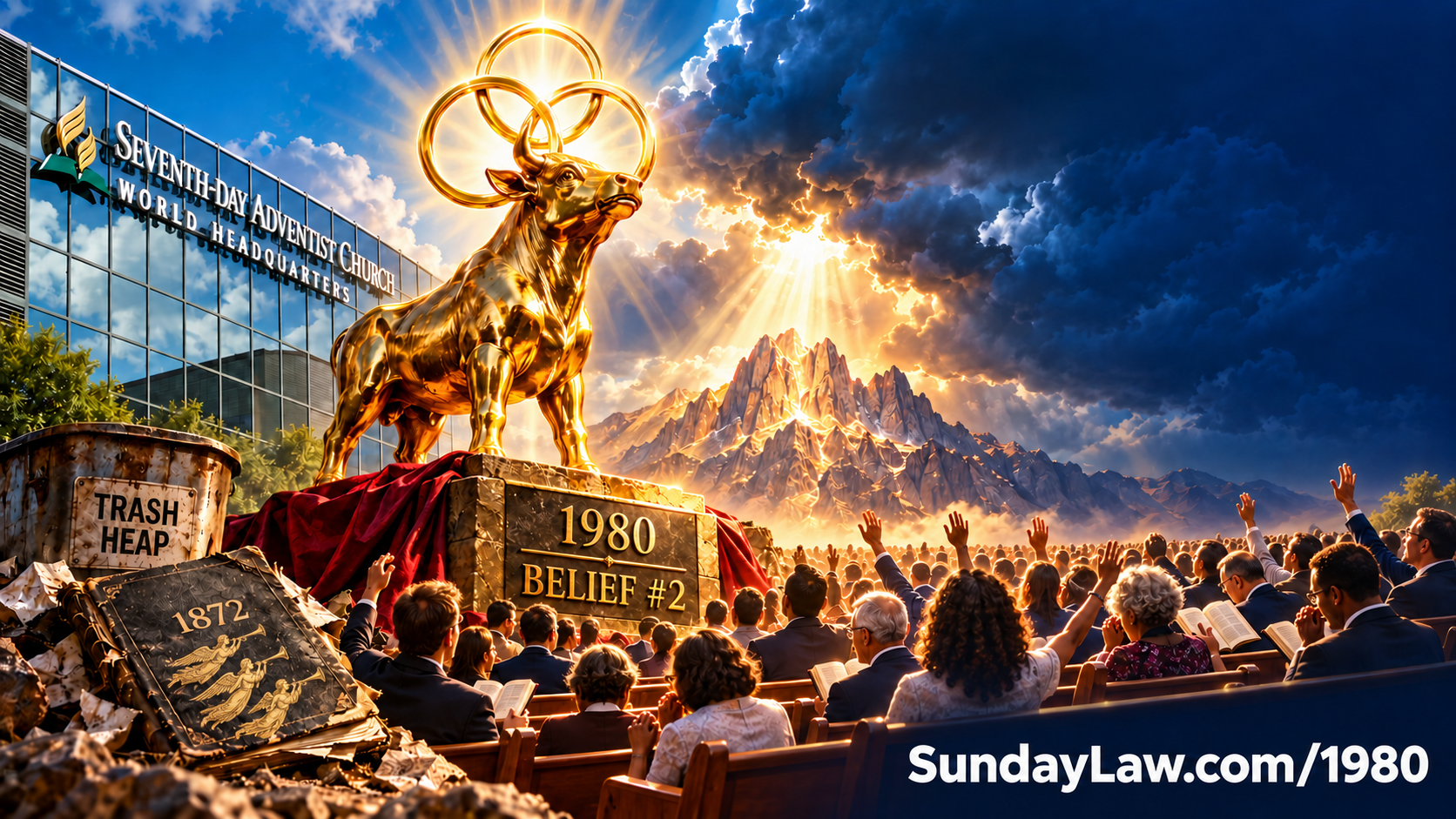
Editorial illustration of a congregation in church pews facing a golden calf labeled “1980 Belief #2,” with a 1872 booklet bearing three flying angels in the foreground and Mount Sinai behind it.
Exhibit: the language before Dallas

1931: “Godhead, or Trinity” Enters the Yearbook Record

The 1931 Adventist Yearbook statement carries the “Godhead, or Trinity” language that later became part of the path to the 1980 Dallas vote. This page lets readers inspect the historical transition between the 1872 pioneer declaration and Fundamental Belief No. 2 adopted in 1980.

The Yearbook record

What did the 1931 statement introduce?

The 1931 statement uses “Godhead, or Trinity” language and describes the Father, Son, and Holy Spirit in a three-person formulation. It stands between the Father-and-Son wording of the 1872 Fundamental Principles and the formal 1980 Session action titled “The Trinity.”

“The Godhead, or Trinity, consists of the Eternal Father, a personal, spiritual Being, omnipotent, omniscient, and omnipresent; the Lord Jesus Christ, the Son of the Eternal Father, through whom all things were created and through whom they do exist; and the Holy Spirit, the third person of the Godhead, the great regenerating power in the work of redemption.”
1931 Seventh-day Adventist Yearbook statement, reproduced in the Adventist Archives compilation of Fundamental Beliefs, 1931–1980. Open the archival compilation.
Three dated witnesses

1872, 1931, and 1980 side by side

YearPublished languageHistorical significance
1872One God, the Father; one Lord Jesus Christ, His Son.The pioneer declaration establishes the earlier Father-and-Son framework.
1931“The Godhead, or Trinity,” with Father, Son, and Holy Spirit described in a three-person formulation.The Yearbook records the terminology decades before the Dallas Session vote.
1980“There is one God: Father, Son, and Holy Spirit, a unity of three coeternal Persons.”The Dallas Session adopted the revised statement with Belief No. 2 titled “The Trinity.”
The pioneer test

What did James White say the Reformation still had to finish?

“The greatest fault we can find in the Reformation is, the Reformers stopped reforming. Had they gone on, and onward, till they had left the last vestige of Papacy behind, such as natural immortality, sprinkling, the trinity, and Sunday-keeping, the church would now be free from her unscriptural errors.”
James White, “The Word,” Advent Review and Sabbath Herald, February 7, 1856, vol. 7, no. 19, p. 148. Read the original scan.

SundayLaw.com reads the 1931 statement as a major marker in the movement away from the pioneer formulation and toward the later Dallas statement. The comparison is direct: the published language changed, and the reader can trace the change in the documents.

Follow the documentary path

Read the next exhibit

A Protestant warning for this generation

Are These Things So?

“As the people go to their former teachers with the eager inquiry, Are these things so? the ministers present fables, prophesy smooth things, to soothe their fears and quiet the awakened conscience. But since many refuse to be satisfied with the mere authority of men and demand a plain ‘Thus saith the Lord,’ the popular ministry, like the Pharisees of old, filled with anger as their authority is questioned, will denounce the message as of Satan and stir up the sin-loving multitudes to revile and persecute those who proclaim it.”

Ellen G. White, The Great Controversy (1911), p. 606.2; originally The Spirit of Prophecy, vol. 4, p. 425.1

The challenge

Ask the question directly

Take these two questions to your pastor, theologian, or conference leader. Ask for a direct answer, then compare the answer with the primary documents:

  1. Who authorized the change from the Protestant pioneer platform to a Catholic-influenced system of authority?
  2. How can something established by God Himself later be called error?

Then watch what happens. Does the answer rest on Scripture and the original record, or on institutional authority, tradition, and the fear of questioning accepted teachers?

One platform, three historical moments

1840–1850

The original Advent band came out of the fallen churches, passed through the Midnight Cry and October 22, 1844, and stood upon the pioneer platform.

1863

The pioneers organized an association of believers and churches for gospel cooperation, unity, and efficiency in labor. This was not itself a civil church-state corporation.

April 15, 1904

This was not a harmless paperwork update. The General Conference Corporation of Seventh-day Adventists was incorporated in Washington, D.C. on April 15, 1904, creating a civil legal structure with the power to hold property, govern institutions, and speak for the denomination under civil law. That incorporated body must be examined as the new organization Ellen White warned about—not casually treated as identical to the original Advent movement built on the pioneer platform.

The platform and the new organization

“As a people, we are to stand firm on the platform of eternal truth that has withstood test and trial. We are to hold to the sure pillars of our faith. The principles of truth that God has revealed to us are our only true foundation. They have made us what we are. The lapse of time has not lessened their value. It is the constant effort of the enemy to remove these truths from their setting, and to put in their place spurious theories.”

Ellen G. White, Selected Messages, book 1, p. 201.2

“The enemy of souls has sought to bring in the supposition that a great reformation was to take place among Seventh-day Adventists, and that this reformation would consist in giving up the doctrines which stand as the pillars of our faith, and engaging in a process of reorganization. Were this reformation to take place, what would result? … A new organization would be established. Books of a new order would be written. A system of intellectual philosophy would be introduced.”

Ellen G. White, Selected Messages, book 1, p. 204.2

“Those who would tear down the foundation that God has laid are not to be accepted as the teachers and leaders of His people.”

Ellen G. White, Selected Messages, book 1, p. 205.3

“The waymarks which have made us what we are, are to be preserved, and they will be preserved, as God has signified through His Word and the testimony of His Spirit. He calls upon us to hold firmly, with the grip of faith, to the fundamental principles that are based upon unquestionable authority.”

Ellen G. White, Selected Messages, book 1, p. 208.2

“In amazement they hear the testimony that Babylon is the church, fallen because of her errors and sins, because of her rejection of the truth sent to her from heaven.”

Ellen G. White, The Great Controversy, Chapter 38, “The Final Warning,” pp. 606–607

Continue the investigation

Read the warning through the original Advent record

Follow the trail from Babylon’s claims, through the Exodus call, into the pioneer biographies and Charles Fitch’s original “Come Out of Her, My People” appeal.

Share This Page - Spread the Final Warning

The Three Angels’ Messages are meant for every nation, kindred, tongue, and people. Share this resource with someone who needs to hear it.