“We are the Seventh-day Adventist Church.”
A song, a claim, and a question for the conscience
New SDA Anthem Song? Testing the Adventist Theme Song Against the Loud Cry
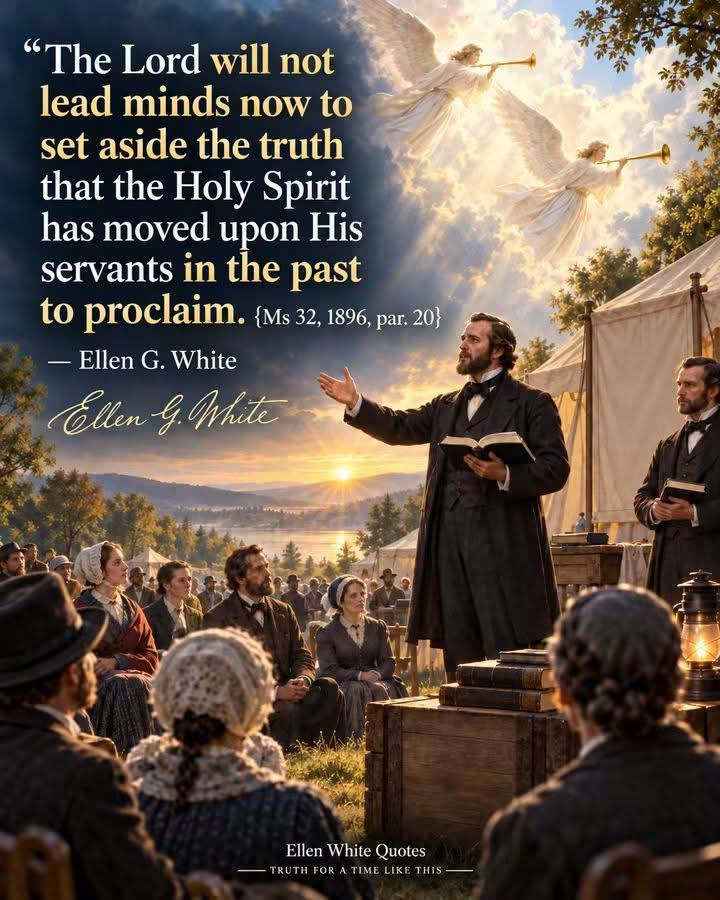
What does the new Adventist anthem say about the Loud Cry?
The featured recording calls itself a Seventh-day Adventist church anthem. It says, “We are the Seventh-day Adventist Church,” and promises that “the loud cry swells and reaches every heart in every land.” This page compares those claims with the pioneers’ message and Ellen White’s warning about corruptions entering the churches since 1844. If the Loud Cry is the call of Revelation 18:4, it must reach every honest heart—including people who hear the song as speaking for them.
The song sings about the Loud Cry. What if the Loud Cry is calling people out of the church whose name it sings and back to the old landmarks and waymarks of the original Advent movement—the unfinished Reformation begun by Martin Luther and others, where the church left behind sprinkling for baptism, the Trinity, and Sunday worship, and moved by faith into the most holy place of the heavenly sanctuary, preparing herself as the bride made ready for Christ in the New Jerusalem?
The YouTube recording is titled Seventh-day Adventist Church Anthem Worship Song for SDA Church | Acapella Rendition. The timestamps below identify its claims for comparison with Scripture and the Advent pioneers’ writings.
Test the song against the sourcesListen closely
What are the lyrics to the SDA mission theme song?
These short excerpts identify the song’s claims. Listen to the full recording above, then compare its language with the scriptural message it invokes.
God raised this people “to bear the threefold light.”
The song speaks of resting in the Sabbath.
It promises to tell the everlasting gospel “far and wide.”
“We await the coming king.”
“The loud cry swells and reaches every heart in every land.”
The song pictures a “finished mission.”
“We are your church.”
The anthem’s repeated institutional “we” is a prideful claim when it invokes the pioneers while setting aside the message they preached. A beautiful tune cannot make an apostate platform the heir to the 1840–1850 movement. The pioneers’ books, sermons, charts, and tracts answer the anthem in their own words.
Listen to the complete recording in the YouTube player, then follow the source links below.
Ellen G. White · The 1844 Advent movement
“Bear witness that it was of God”
“Of all the great religious movements since the days of the apostles, none have been more free from human imperfection and the wiles of Satan than was that of the autumn of 1844. Even now, after the lapse of many years, all who shared in that movement and who have stood firm upon the platform of truth still feel the holy influence of that blessed work and bear witness that it was of God.”
— Ellen G. White, The Great Controversy (1911), p. 401.3
First published in The Spirit of Prophecy, vol. 4 (1884), p. 250. The 1884 printing reads “after the lapse of forty years”; the later Great Controversy text reads “many years.” Compare the 1884 edition scan.
A claim measured by the message
What is the everlasting gospel the anthem promises to tell “far and wide”?
The song promises to carry the everlasting gospel “far and wide.” Yet the 501(c)(3) GENERAL CONFERENCE OF SEVENTH DAY ADVENTIST corporate platform singing those words has rejected the pioneer gospel itself: the full three angels’ messages, the commandments of God, the faith of Jesus, and Christ’s ministry in the most holy place. The pioneers’ writings expose the contradiction between the anthem’s promise and the message the 501(c)(3) GENERAL CONFERENCE OF SEVENTH DAY ADVENTIST has thrown into the trash.
The angel of Revelation 14 proclaims “the everlasting gospel” to every nation, kindred, tongue, and people; the message calls the world to worship the Creator, announces Babylon’s fall, and warns against worshipping the beast and receiving its mark (Revelation 14:6–12, KJV). The third angel’s message is the complete gospel of salvation in Jesus—the gospel that restores obedience, faith, and readiness to follow the Lamb.
“The whole of the gospel is embraced in the third angel’s message, and in all our work the truth is to be presented as it is in Jesus. In the preaching of the Word the first and most important thing is to melt and subdue the soul by presenting the Lord Jesus Christ as the sin-pardoning Saviour. We are to keep before the people the cross of Calvary.”
— Ellen G. White, The Three Angels’ Messages, quoting Manuscript 19, 1900, par. 4
The anthem’s “far and wide” promise rings hollow while the corporate church rejects the everlasting gospel the pioneers proclaimed. It speaks of the gospel while rejecting its substance, and cannot proclaim what its platform has discarded. James White declared the Reformation unfinished: the Sabbath, sanctuary, nature of man, and the non-immortality of the soul remained truths to recover. He named the Trinity and Sunday-keeping among the “unscriptural errors” carried forward from papal tradition.
Just as the Protestant awakening of 1830–1850 sent multitudes searching Scripture and preparing for Christ’s return, the reformation must go forward today. Follow Christ whithersoever He leads—into His sanctuary ministry in the most holy place and into every truth the pioneers recovered.
“The Reformation was never completed. The reformers stopped reforming. The Sabbath, the Sanctuary, the nature of man, and the non-immortality of the soul, are truths which the reformers did not reach. The last message of mercy is to complete the work of reform.”
— James White, Advent Review and Sabbath Herald, February 7, 1856, vol. 7, no. 19, p. 148; read the original scan
“The greatest fault we can find in the Reformation is, the Reformers stopped reforming. Had they gone on, and onward, till they had left the last vestige of Papacy behind, such as natural immortality, sprinkling, the trinity, and Sunday-keeping, the church would now be free from her unscriptural errors.”
— James White, “The Word,” Advent Review and Sabbath Herald, February 7, 1856, vol. 7, no. 19, p. 148; open the original scan
Jesus is the anchor of this gospel. Ellen White wrote, “He is anchored in Christ” (That I May Know Him, p. 79.5). Scripture calls this hope “an anchor of the soul, both sure and stedfast” (Hebrews 6:19, KJV) and declares, “For other foundation can no man lay than that is laid, which is Jesus Christ” (1 Corinthians 3:11, KJV). The rotten timbers of the corporate platform have left it adrift, severed from Jesus Christ, the anchor of the soul. Follow Christ by faith into the most holy place of the heavenly sanctuary.
The central question
Can the Loud Cry reach people inside the church?
Revelation’s call is addressed to people God still calls His own: “Come out of her, my people, that ye be not partakers of her sins” (Revelation 18:4, KJV). The phrase my people makes the appeal personal. The question is not whether a person inherited a name, sang an anthem, or was born into a tradition. The question is whether the message and the life agree with the Scriptures.
“The message of the fall of Babylon, as given by the second angel, is repeated, with the additional mention of the corruptions which have been entering the churches since 1844.”
— Ellen G. White, Early Writings, p. 277.1
White continues that the angel’s work joins “the last great work of the third angel’s message as it swells to a loud cry.” The song celebrates that crescendo; the pioneer warning declares that the Loud Cry exposes corruptions entering the churches since 1844. The call of Revelation 18:4 reaches the people still inside: “Come out of her, my people.” The modern corporate church bears the Adventist name while opposing the foundation the pioneers laid.
Sit down with the record
How did James White’s little paper preserve the Advent movement’s history?
In 1903, Ellen White gave the Advent people a sacred assignment: as Moses rehearsed the Lord’s dealings with Israel, they must rehearse the Lord’s dealings through the Advent wilderness journey. She called for the early Advent experience to be republished so later believers would know how the work began, naming William Miller and his associates, Captain Joseph Bates, and the other pioneers.
“The record of the experience through which the people of God passed in the early history of our work must be republished.”
— Ellen G. White, Letter 105, 1903, par. 4; read the letter in context
Years earlier, White described a vision in which James was told to begin “a little paper” that would start small and spread “like streams of light” around the world. The first issue of The Present Truth appeared in July 1849, and it became the movement’s printed voice in the wilderness. Read the original vision, the April and July 1849 issues, and the local reading page for yourself.
“You must begin to print a little paper and send it out to the people.”
— Ellen G. White, Early Writings, p. xxiv.2; see also the Andrews University archive record
God commissioned James White to print the little paper that carried present truth to the scattered flock. Like Moses rehearsing Israel’s history, the paper gathered the Advent people around God’s providential leading, the prophetic waymarks, and the truths entrusted to the pioneers. The mandate remains: read the Bible, the early publications, and the later record together.
The historic platform and the present claim
What did the pioneers mean by the “threefold light”?
The “threefold light” is the three angels’ messages of Revelation 14:6–12, KJV: the first angel’s everlasting gospel and judgment-hour announcement (verses 6–7), the second angel’s announcement of Babylon’s fall (verse 8), and the third angel’s solemn warning (verses 9–12). The pioneers preached this prophetic sequence alongside the Sabbath and Christ’s ministry in the heavenly sanctuary. In MS 32, 1896, Ellen White wrote that all three messages must still be proclaimed together, and that no “peg or pin” was to be removed from their prophetic order. The anthem claims this threefold light; the pioneers’ publications define its message and expose its abandonment by the modern corporate platform.
“The great waymarks of truth, showing us our bearings in prophetic history, are to be carefully guarded, and the Lord has sent his angels to preserve them from being swept away by the speculations of men.”
— Ms 31, 1896. EGW Writings
“When men come in who would move one pin or pillar from the foundation which God has established by His Holy Spirit, they are working against the Lord, and they will find that the Lord is not with them.”
— Ms 62, 1905. EGW Writings
“Do not remove the landmarks that have been established by the Holy Spirit’s witness.”
— Lt 150, 1903. text.egwwritings.org
“When the power of God testifies as to what is truth, that truth is to stand forever as the truth.”
— Lt 329, 1905, par. 17. Ellen G. White Writings
“We have nothing to fear for the future, except as we shall forget the way the Lord has led us, and His teaching in our past experience.”
— Life Sketches, p. 196
Adventist Pioneer LibraryRead the historic books, periodicals, sermons, and tracts. Prophetic chartsStudy the 1843 and 1850 charts in their historic setting. The heavenly sanctuaryFollow the pioneer teaching on Christ’s ministry. The Three Angels’ MessagesRead the messages invoked by the anthem. James WhiteRead a pioneer’s writings in his own words. Captain Joseph BatesRead the Sabbath pioneer’s testimony and books.
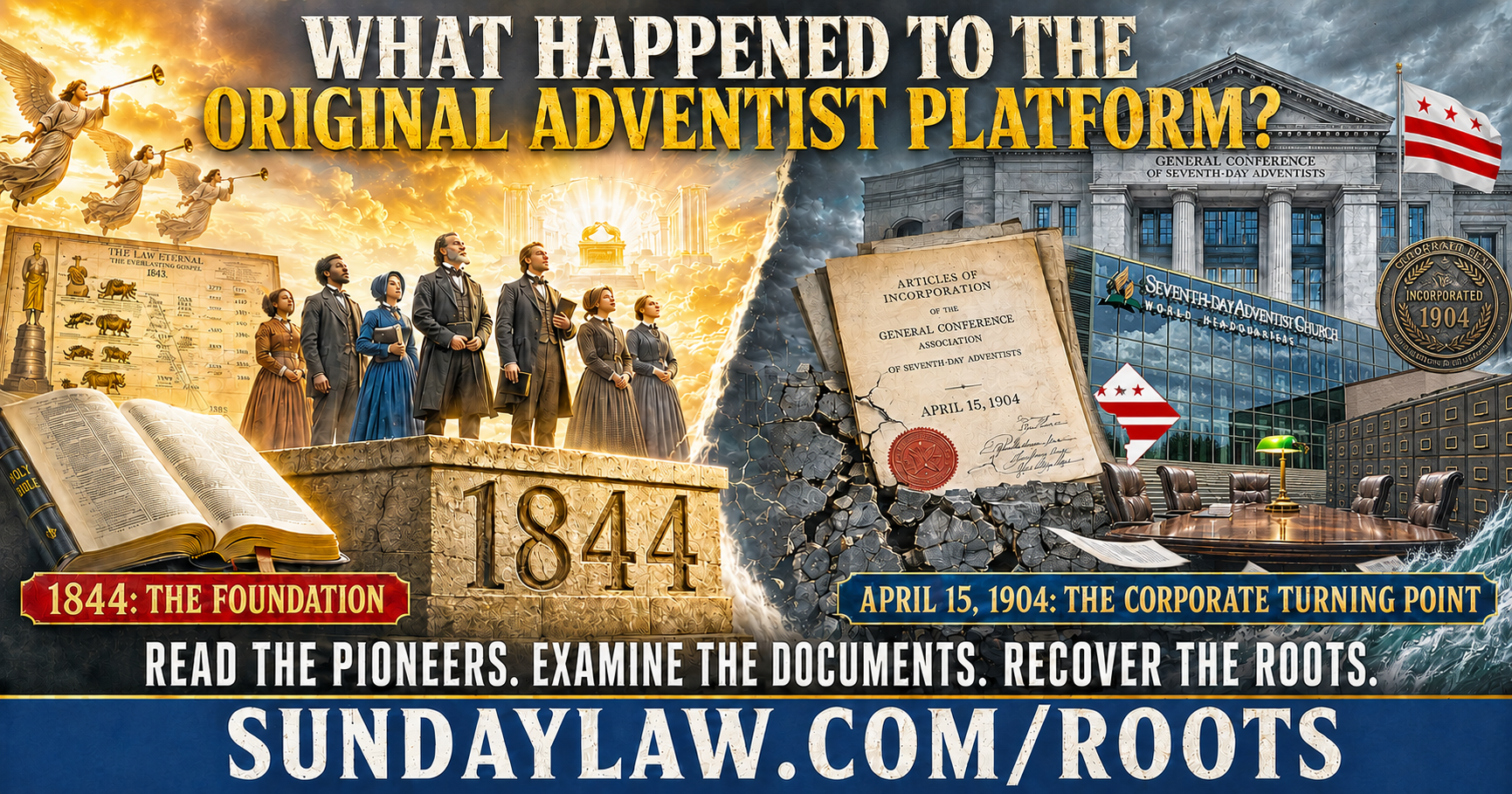
Inspect the image up to 10×
The image presents the contrast; the linked scans and publications provide the dated historical record.
The divided platform
Are the pioneer platform and the corporate institution the same claim of identity?
The original Adventist platform of 1840–1850 and the General Conference’s 501(c)(3) corporate empire, incorporated on April 15, 1904, are two conflicting claims to the Adventist name. The pioneers’ message is the standard: the everlasting gospel, the commandments of God, the faith of Jesus, and Christ’s work in the heavenly sanctuary. Jesus’ parable divides those who have the oil of the Holy Spirit from those whose lamps are going out. The present church’s doctrines and fruit show which platform it follows.
The 1840–1850 foundation
Trace the Millerite prophetic waymarks, the Sabbath, the sanctuary, and the first publications through pioneer books and charts. Ellen White’s 1903 appeal was to rehearse this history and preserve the pioneers’ experience.
Follow the pioneer roots Compare the prophetic charts Open the pioneer libraryThe later corporate structure
The General Conference Corporation’s April 15, 1904 incorporation and its trademark policies show the institutional platform that claims the Adventist name. Its corporate authority has been used to control that name while the original pioneer message is rejected, its witnesses silenced, and the old foundation displaced.
Read the 1904 incorporation record Review corporate records Study the name’s historyRead the records, compare the doctrines, and test the claims against Scripture. The name’s history and corporate records are part of the evidence; the pioneers’ own books, charts, sermons, and tracts reveal the message the modern platform abandoned.
The heralds and their charge
Was the early Advent movement only a theological childhood?
The John the Baptist movement
Ellen White placed William Miller and those who joined him in the line of sacred heralds who prepared the way for Christ:
“As John the Baptist heralded the first advent of Jesus, and prepared the way for his coming, so also, Wm. Miller and those who joined him, proclaimed the second advent of the Son of God.”
— Ellen G. White, Spiritual Gifts, vol. 1, p. 129.1
John cried, “Prepare ye the way of the Lord, make his paths straight” (Matthew 3:3, KJV). William Miller and the Millerite heralds opened Daniel, proclaimed the judgment hour, and awakened the churches to prepare for Christ’s return. Charles Fitch proclaimed Babylon’s fall and the call of Revelation 18:4: “Come out of her, my people.”
James White’s command to hold fast
“The third angel’s message was, and still is, a WARNING to the saints to ‘hold fast,’ and not go back, and ‘receive’ the marks which the virgin band got rid of, during the second angel’s cry.”
— James White, A Word to the “Little Flock,” 1847, p. 11
The pioneer message called believers forward with Christ into truth, away from the errors exposed by the second angel. Follow the Lamb “whithersoever he goeth” (Revelation 14:4, KJV), and follow Him by faith into the most holy place of the heavenly sanctuary.
A parable of recovery—and a caution
What do Miller’s dream and Gehazi’s account teach about recovery and accountability?
James White recorded the dream and its notes in a way that made the meaning plain: the Bible truths about Christ’s soon return were like a treasure chest hidden beneath a heap of rubbish; the key was the right rules of Bible interpretation; the jewels were the precious truths of the Advent message; the counterfeit or spurious coin represented the false, man-made ideas that imitate real truth; and the larger casket represented the full restored Advent platform of the sanctuary, the Sabbath, the seal, and the 144,000. The dream is not a vague symbol; it is a picture of the precious truths God raised up in the Advent movement and the counterfeit forms that seek to replace them. That is why the pioneers’ writings must be recovered, read in context, and tested by Scripture.
The Bible records Gehazi’s pursuit of Naaman after Elisha refused a gift, Gehazi’s lie, and the judgment that followed (2 Kings 5:20–27, KJV). Elisha’s rebuke stands as a warning against coveting gifts and taking glory from God’s work. The White Estate and Gehazi study applies this warning to the seizure and control of the pioneers’ writings: honor the prophets, preserve their testimony, and give God the glory.
A warning to the sleeping
What do the wise and foolish virgins teach?
At 1:37 the anthem says, “We await the coming king.” In Jesus’ parable, both wise and foolish virgins expect the bridegroom. When the cry sounds, they all rise; the difference is whether they have oil. Read Matthew 25:1–13, KJV beside Christ’s counsel to Laodicea. The lamp must burn with the oil of the Holy Spirit, and the soul must receive Christ’s counsel. Study the doctrines that plead with the heart to search the Scriptures and follow Christ in the sanctuary: the Holy Spirit, the Spirit of Christ, the begotten Son, the “if” passages, Sonship, the Trinity, the sanctuary, the Most Holy Place, and the New Jerusalem.
“The class represented by the foolish virgins” have not yielded themselves to the Holy Spirit’s working. “They do not know God. They have not studied His character; they have not held communion with Him; therefore they do not know how to trust, how to look and live. Their service to God degenerates into a form.”
— Ellen G. White, Christ’s Object Lessons, p. 411.1
This is Laodicea’s peril: “I am rich, and increased with goods, and have need of nothing,” while Christ says, “thou art wretched, and miserable, and poor, and blind, and naked” (Revelation 3:17, KJV). His remedy is gold tried in the fire, white raiment, eyesalve, repentance, and fellowship with Him (verses 18–20).
“Study the ninth chapter of Ezekiel. These words will be literally fulfilled; yet the time is passing, and the people are asleep.”
— Ellen G. White, Letter 106, 1909, par. 17; read the full letter
The warning continues: hear Christ’s voice, open the door, and receive His counsel. Compare the pioneer doctrines with the 1980 record and the prophetic teaching on the image of the beast and the great test.
The seal, the settling, and the shaking
“It is not any seal or mark that can be seen, but a settling into the truth, both intellectually and spiritually, so they cannot be moved.” When God’s people are sealed and prepared for the shaking, “it will come. Indeed, it has begun already; the judgments of God are now upon the land, to give us warning, that we may know what is coming.”
— Ellen G. White, Manuscript 173, 1902, quoted in The SDA Bible Commentary, vol. 4, p. 1161
The seal is God’s truth settled in the mind and heart. The shaking tests whether the professed people of God are anchored in Jesus, filled with the Spirit of Christ (Gal. 4:6, KJV), and faithful to the commandments and the faith of Jesus. It is not a musical sentiment; it is a test of whether the soul is truly united with Christ through the Holy Spirit and the truth of God. Read the heart of the issue in the Holy Spirit, the Spirit of Christ, Baptism, and the teachings that call the soul back to the old landmarks of the Advent movement.
The record behind the refrain
What does the anthem’s timeline reveal about the movement?
Babylon’s fall and the Advent disappointment
Early Writings describes a repeated second-angel message that names corruptions entering the churches since 1844. Begin with the call to come out and the writings of Charles Fitch.
A warning of “a Catholic procession”
In Testimonies for the Church, vol. 1, pp. 577–578, White recounts a dream in which a company she knew later “presented the appearance of a Catholic procession.” Follow this warning through the Crossroads study.
“Another coming out”
White wrote, “We hoped that there would not be the necessity for another coming out” (Manuscript 30, 1889, par. 14). Read the quotation and context on the Wealth page.
A civil corporation bearing the church’s name
The General Conference Corporation was incorporated in Washington, D.C., on April 15, 1904. See the incorporation documents and 1904 timeline.
A vote on Fundamental Belief No. 2
Read the April 25, 1980 Dallas General Conference Session record and compare it with the pioneer writings on the Father and His Son, the Sonship question, and the “if” passages.
“Another universal and truly Catholic organization”
The March 5, 1981 Adventist Review records a visitor describing the worldwide church as “another universal and truly Catholic organization.” Read the original issue and compare its institutional language with the pioneers’ Protestant warning.
The anthem calls the church “we”
At 4:59 the recording pleads, “We are your church.” Christ’s counsel to Laodicea is, “Be zealous therefore, and repent” (Revelation 3:19, KJV). The Bridegroom knows those who follow Him.
The foundation and the test
What did Ellen White warn about a “new organization”?
“A new organization would be established. Books of a new order would be written. A system of intellectual philosophy would be introduced.” She also wrote: “The Sabbath of course, would be lightly regarded, as also the God who created it.”
— Ellen G. White, Selected Messages, book 1, p. 204.2
White also warned that “the image of the beast will be formed before probation closes,” calling it “the great test for the people of God” (Selected Messages, book 2, p. 80.4). This warning stands beside the 1904 corporation, the corporate records, and the 1980 doctrinal vote.
Tithes, offerings, and accountability
What does the anthem leave unsung about the money?
The anthem celebrates Sabbath rest. The General Conference Capital Preservation Fund Trust schedule dated December 31, 2013 lists securities including JPMorgan Chase, Morgan Stanley, Lehman Brothers, HSBC Finance, Ford Motor Credit, Toyota Motor Credit, General Electric Capital, and Simon Property Group. The General Conference Corporation is identified as trustee. These are the investments and financial relationships that make the stewardship of the church’s tithes and offerings a matter of conscience.
The schedule places church-controlled funds in bonds and securities of corporations in the financial, automotive, retail, and manufacturing sectors—businesses that trade and profit through the Sabbath. Ellen White’s counsel is direct: tithe sustains the ministers appointed to speak words of life. The complete evidence and the church’s investment and insurance records are gathered on the Wealth page.
“The tithe is to be used for one purpose—to sustain the ministers whom the Lord has appointed to do His work.”
— Ellen G. White, Pastoral Ministry, p. 261.3
Follow the warning about old landmarks and “books of a new order” through the dated documents on the Changed source study.
“Of what value is untold wealth, if it is hoarded in expensive mansions, or in bank stock?”
— Ellen G. White, Counsels on Stewardship, p. 38.2
SundayLaw.com applies this principle: when tithes and offerings enter corporate systems, and those corporations operate on the Sabbath or profit from labor on God’s holy day, the profit is shared—and so is the responsibility. Participation is not erased by distance. What is supported is shared. This is why Scripture says, “Come out of her, my people, that ye be not partakers of her sins” (Revelation 18:4, KJV).
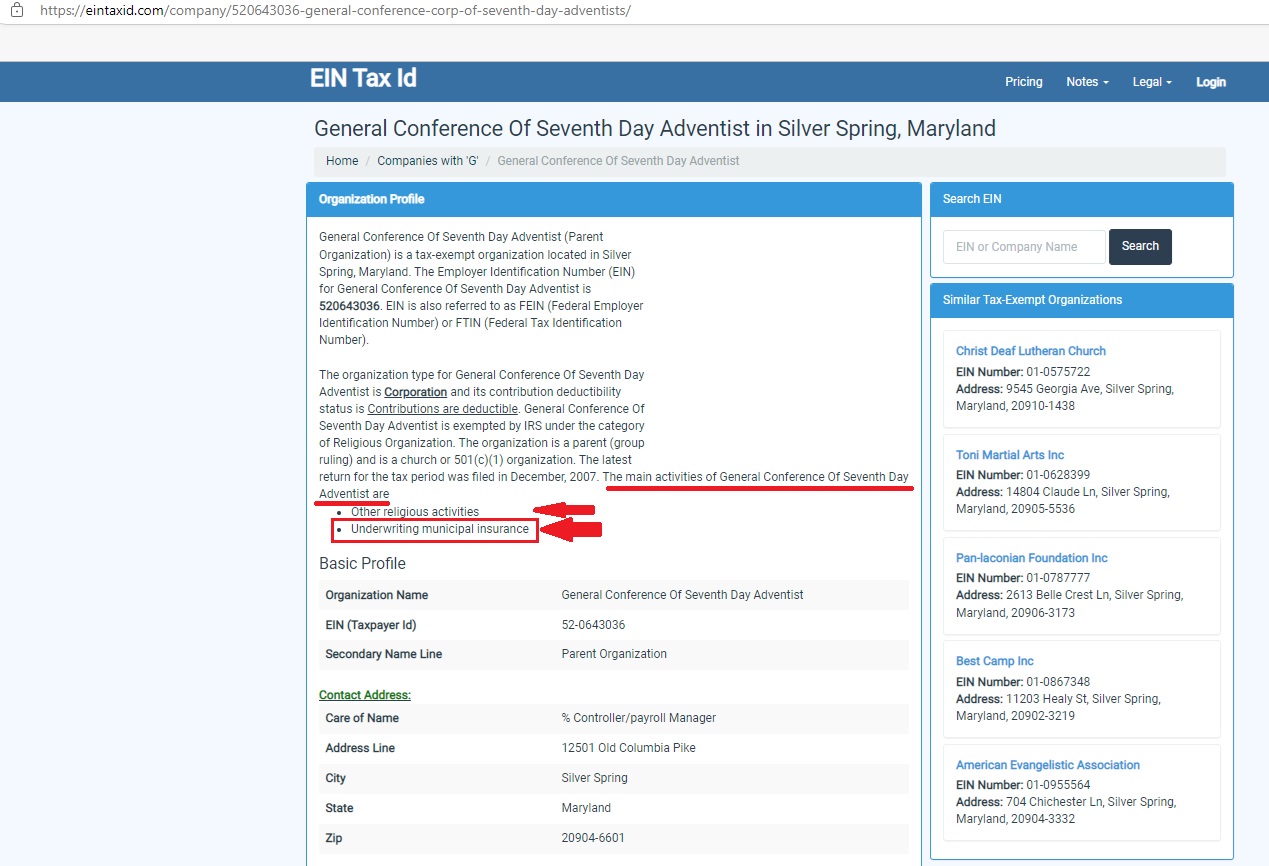
Organization profile image for EIN 52-0643036. The filing lists “underwriting municipal insurance” among the General Conference’s activities. Read the accompanying insurance record and the related investment evidence on the Wealth page.
The corporate church’s Sabbath profession stands beside these investment and insurance records. Read the documented financial evidence and the Adventist hospital records.
A question of worship
Can an idea become an idol without an image?
“No outward shrines may be visible, there may be no image for the eye to rest upon; yet we may be practicing idolatry. It is as easy to make an idol of cherished ideas or objects as to fashion gods of wood or stone.”
— Ellen G. White, Testimonies for the Church, vol. 5, p. 173.4
Ellen White warns that cherished ideas can become idols enshrined in the place of God. James White names the Trinity among the “unscriptural errors” the Reformation left behind; the modern corporate platform has enthroned that creed as a fundamental belief. Compare the pioneer testimony of James White and Joseph Bates with the Bible and the studies on the Trinity, the Sonship, and the “if” passages.
The warning and the record
What did the 1981 Adventist Review print?
The March 5, 1981 Adventist Review records a visitor’s description of the worldwide Seventh-day Adventist Church as “another universal and truly Catholic organization.” This public institutional language stands in stark contrast with the pioneers’ warnings against Rome and their call to continue reforming.
Set that account beside the church’s 1904 incorporation documents, the pioneers’ Protestant warning, and the writings of Charles Fitch. Ask where the uncompromised warning of the pioneers can be heard today.
Hear, compare, and choose
What is the answer to Laodicea?
At 3:24 the song pictures a “finished mission.” At 4:59 it says, “We are your church.” Christ’s answer to Laodicea is a call to repent: “Be zealous therefore, and repent” (Revelation 3:19, KJV). The mission is fulfilled by people who receive His counsel and carry His message, wherever obedience leads them.
“I saw that as Jesus was rejected, so I saw that these messages have been rejected. And as the Jews crucified Jesus, so I saw that these messages have been crucified. And those who reject them show contempt for Jesus, who is leading His people step by step.”
— Ellen G. White, The Great Controversy (1858), p. 75
Brother Miller dreamed of precious jewels buried under dirt and rubbish. Bring them out. Read the pioneer books. Recover the sanctuary, the Sabbath, the gospel, and the testimony concerning the Son of God. Search the KJV. Let the Scriptures expose every counterfeit jewel.
A sober appeal
What does Ellen White say about blaming God for a wrong course?
“We may have to remain here in this world because of insubordination many more years, as did the children of Israel; but for Christ’s sake, His people should not add sin to sin by charging God with the consequence of their own wrong course of action. Now, have men who claim to believe the Word of God learned their lesson that obedience is better than sacrifice?”
— Ellen G. White, Manuscript Releases, vol. 20, p. 313.1
White continues that the churches should use their strength, capabilities, talents, and means to carry the work, and urges repentance for “departing from the truth of God and following human devising” (20MR 313.2–3). Read paragraph 2 and paragraph 3 in context.
Is the Loud Cry reaching Adventists too?
The Loud Cry calls God’s people out of every system that has departed from the message entrusted to the pioneers—and back to the original Advent platform. Hear the call for yourself. Compare the records. Search the KJV. Then rise and follow the Bridegroom:
“Behold, the bridegroom cometh; go ye out to meet him.” — Matthew 25:6, KJV
Questions and answers
What should a listener check?
What are the latest SDA songs?
This page examines the YouTube recording “Seventh-day Adventist Church Anthem Worship Song for SDA Church | Acapella Rendition,” with selected timestamps and the pioneer sources that test its claims.
What are the lyrics to the SDA mission theme song?
Listen to the featured recording and compare its lines at 0:16, 0:41, 0:58, 1:18, 1:37, 2:41, 3:24, and 4:59 with the Scriptures and pioneer writings cited here.
What is the everlasting gospel the anthem promises to spread?
Ellen White wrote that the gospel for this time is comprised in the third angel’s message, which embraces the first and second angels, and that “the whole of the gospel is embraced in the third angel’s message.” She said the truth must be presented as it is in Jesus, the sin-pardoning Saviour, with the cross of Calvary kept before the people (Review and Herald, October 31, 1899; Manuscript 19, 1900). Read Ellen White on the everlasting gospel
What was James White’s “little paper”?
Ellen White’s account in Early Writings says James was commissioned to begin a small paper that would spread like streams of light around the world. James White began publishing The Present Truth in July 1849, and the Advent message was carried through that paper from the beginning of the movement. Read James White’s The Present Truth
Who are the foolish virgins in Ellen White’s explanation?
Ellen White wrote that the foolish virgins “have not yielded themselves to the Holy Spirit’s working,” “do not know God,” and that their service “degenerates into a form” (Christ’s Object Lessons, p. 411.1). Jesus calls Laodicea to receive His counsel, repent, and open the door to Him (Revelation 3:17–20, KJV). The Holy Spirit is the life-giving power that cleanses, teaches, and leads the heart back to Christ, and this question is answered more fully on the Holy Spirit page. Read the Holy Spirit page
Where can I read the investment and tithes-and-offerings evidence?
The Wealth page presents the General Conference Capital Preservation Fund Trust schedule, identifies the General Conference Corporation as trustee, and examines the listed bonds, insurance activity, and the stewardship of tithes and offerings. Read the Wealth page and its source documents
Do Seventh-day Adventist congregations generally hold Sunday worship?
Ellen White describes the company who had once kept the Sabbath and then gave it up. “On their garments was written in large characters, ‘Thou art weighed in the balance, and found wanting.’” The angel identified them: “These are they who have once kept the Sabbath and have given it up.” When they saw the writing, “they would wail aloud” (Early Writings, p. 36.2). Read “The Sealing” in Early Writings