Read Omitted Statements in the later appendix of A Word to the Little Flock. Ellen G. White. Reading section numbers identify this online edition; bracketed numbers in the text preserve its source page references.
Table of contents · Find a chapter or search the book
Search the text and share a passage
Type a word or several nearby keywords. Select passages to copy or share with their source, direct reading link, preview artwork, and invitation to revive the Advent pioneer books.
“‘It was just as impossible for them [those that gave up their faith in the '44 movement] to get on the path again and go to the city as all the wicked world which God had rejected. They fell all the way along the path one after another.’ [Page 14.] 
“I will give the context, that the full force of the expressions may be clearly seen: 
“While praying at the family altar, the Holy Ghost fell on me, and I seemed to be rising higher and higher, far above the dark world. I turned to look for the Advent people in the world, but could not find them—when a voice said to me, “Look again, and look a little higher.” At this I raised my eyes and saw a straight and narrow path, cast up high above the world. On this path the Advent people were traveling to the city, which was at the farther end of the path. They had a bright light set up behind them at the first end of the path, which an angel told me was the Midnight Cry. This light shone all along the path, and gave light for their feet so they might not stumble. And if they kept their eyes fixed on Jesus, who was just before them, leading them to the City, they were safe. But soon some grew weary, and they said the City was a great way off, and they expected to have entered it before. Then Jesus would encourage them by raising His glorious right arm, and from His arm came a glorious light which waved over the Advent band, and they shouted Hallelujah. Others rashly denied the light behind them, and said that it was not God that had led them out so far. The light behind them went out leaving their feet in perfect darkness, and they stumbled and got their eyes off the mark and lost sight of Jesus, and fell off the path down in the dark and wicked world below.’ 
“‘It was just as impossible for them [those that gave up their faith in the ’44 movement] to get on the path again and go to the City, as all the wicked world which God had rejected. They fell all the way along the path one after another.’ 
“It is claimed that these expressions prove the shut door doctrine, and that this is the reason of their omission, in later editions. But in fact they teach only that which has been and is still held by us as a people, as I shall show. 
The first vision · The old landmarks · The state of Laodicea
Keep your eyes on Jesus. Do not deny the light behind you.
Ellen White’s first vision was given in December 1844. It pictured the Advent people on a narrow path to the city, with the Midnight Cry shining behind them. The warning is not merely an antique controversy: professing the faith while rejecting its light leaves a person in darkness.
This is SundayLaw.com’s present-day study and application, separate from the historical appendix above. Its conclusions are to be tested by Scripture and the linked original sources. No explanatory brackets have been inserted into the source paragraphs.
Days since December 31, 1844
First vision: December 1844. Enable JavaScript to calculate the day count for your current local date.
The first vision is documented as December 1844, without an established day. This counter uses December 31, 1844 as a fixed end-of-month reference, not a claim about the exact vision date. It refreshes at your local midnight and when you return to this page. Read the historical dating evidence.
What the historical sources establish about the date
Ellen Harmon received her first vision one morning in December 1844, while praying with four other women at Mrs. Haines’s home in Portland, Maine. The month and occasion are documented; a numbered day is not.
Ellen White to Joseph Bates, July 13, 1847: “The Lord showed me the travel of the Advent band and midnight cry in December, but He did not show me the Bridegroom’s coming until February following.” Letter 3, 1847, paragraph 3. This also distinguishes the first vision from the later Bridegroom vision.
Her published account, 1851: she places the occasion in December 1844, describes morning family worship, and states that five women were present. Experience and Views, p. 5.3.
Keep three dates separate: December 1844 is the vision’s date; December 20, 1845, is the date of the letter recounting it; January 24, 1846, is that letter’s publication in the Day-Star. The latter two do not establish the day of the vision. Read the publication history in Early Writings, p. 297.1.
“As the appearance of the bow that is in the cloud in the day of rain, so was the appearance of the brightness round about. This was the appearance of the likeness of the glory of the LORD. And when I saw it, I fell upon my face, and I heard a voice of one that spake.”
Ezekiel 1:28, King James Version. The rainbow colors recall this description; they are not a substitute for its message.
Read the vision before applying it
The appendix quotes the path, the Midnight Cry, those who kept their eyes upon Jesus, and those who denied the light. It also explains the disputed omission. Read all of it, rather than treating a detached sentence as the whole vision.
The angel specifically identified the light as the Midnight Cry. SundayLaw.com connects that light with the unfolding first, second, and third angels’ messages and the pioneer experience of 1840–1850. That broader application should not be substituted for the vision’s own wording.
“Those that gave up their faith in the ’44 movement” is an explanatory bracket already present in the later appendix. The links to the 1904 organization, old landmarks, city, and doctrinal departures here are modern study connections, not part of the original vision.
“Look a little higher”: follow Christ by faith, not by bodily ascent
“I turned to look for the Advent people in the world, but could not find them” directs attention above the world, to Christ and the heavenly destination. SundayLaw.com reads this alongside the later sanctuary vision: the faithful sent their faith to Jesus in the Holiest. They remained on earth; the vision does not say they had physically entered heaven.
“They were not to be present in person at the marriage; for it takes place in heaven, while they are upon the earth.”
The same paragraph explains that believers understand His work and follow Him by faith. Page 428.1 connects the examination of the wedding guests’ character with the investigative judgment. To discard this ministry while retaining the Advent name is to discard a central part of the pioneer message.
The praying companies · A warning against false worship
Religious light and power are not proof that Christ is leading
The December 1844 path vision and this later sanctuary vision must be read together, but they are not the same vision. The passage published in the Day-Star on March 14, 1846, describes the Father, His Son, those who followed Jesus by faith into the Holiest, and those who remained at the throne He had left.
Those who rose up when Jesus did, kept their eyes fixed on him as he left the throne, and led them out a little way, then he raised his right arm and we heard his lovely voice saying, wait ye, I am going to my Father to receive the Kingdom. Keep your garments spotless and in a little while I will return from the wedding, and receive you to myself. And I saw a cloudy chariot with wheels like flaming fire. Angels were all about the chariot as it came where Jesus was; he stepped into it and was borne to the Holiest where the Father sat. Then I beheld Jesus as he was before the Father a great High Priest. On the hem of his garment was a bell and a pomegranate, a bell and a pomegranate. Then Jesus shewed me the difference between faith and feeling. And I saw those who rose up with Jesus send up their faith to Jesus in the Holiest, and praying, Father give us thy spirit. Then Jesus would breathe on them the Holy Ghost. In the breath was light, power and much love, joy and peace. Then I turned to look at the company who were still bowed before the throne. They did not know that Jesus had left it. Satan appeared to be by the throne trying to carry on the work of God. I saw them look up to the throne and pray, My Father give us thy spirit. Then Satan would breathe on them an unholy influence. In it there was light and much power, but no sweet love, joy and peace. Satan's object was to keep them deceived and to draw back and deceive God's children. I saw one after another leave the company who were praying to Jesus in the Holiest, go and join those before the throne and they at once received the unholy influence of Satan.
Ellen G. Harmon, The Day-Star, March 14, 1846, paragraph 1; local PDF scan 5, internal text p. 9, par. 1. Read the original PDF, scan 5. Bold emphasis is added; the wording is unchanged.
A warning against false worship and an unholy influence
The warning is devastating: a company can be praying, expecting the Spirit, and experiencing light and power, yet receive an unholy influence while imagining it is worshiping God. The distinction given in the vision includes love, joy, and peace, and whether the worshipers followed Jesus in His actual heavenly ministry—not merely whether their religion appeared powerful.
SundayLaw.com applies this warning to the replacement of the pioneer Father–Son teaching with the Trinity and to the rejection of the sanctuary light. The Trinity study and Trinitarian comparison set out that doctrinal argument: a familiar religious name or an impressive spiritual experience cannot make a departure from revealed truth safe.
The original passage identifies the companies by their response to Jesus and His ministry; it does not use the word “Trinity” or name a modern denomination. The connection made here is the site’s theological application, not an added sentence attributed to Ellen Harmon. Test that application against the pioneers’ actual Father–Son testimony and the sanctuary sources.
The judgment, the wedding garment, and a people prepared
The investigative judgment concerns who is ready for Christ’s kingdom. Esther’s preparation and selection (Esther 2:12–17) can illustrate preparation for the King, but this is a Bible-study analogy, not an explanation explicitly given in the first vision.
Scripture uses more than one marriage picture. Revelation 21:9–10 identifies the New Jerusalem as the bride; Ephesians 5:25–32 uses marriage to describe Christ and His church. The Great Controversy, pp. 426–428, distinguishes the city as bride from the church as virgins and wedding guests. Those distinctions must not be erased when discussing the 144,000 as a specially prepared people who follow the Lamb (Revelation 14:1–5).
SundayLaw.com’s bridal application emphasizes character, loyalty, and preparation, not a claim that the vision itself defines the bride as the 144,000. Like Elijah and John the Baptist, the people who prepare the way must call for repentance and restoration (Malachi 4:5–6; Luke 1:16–17). A religious name cannot supply the missing oil.
Return to the old landmarks — inspect, download, and share
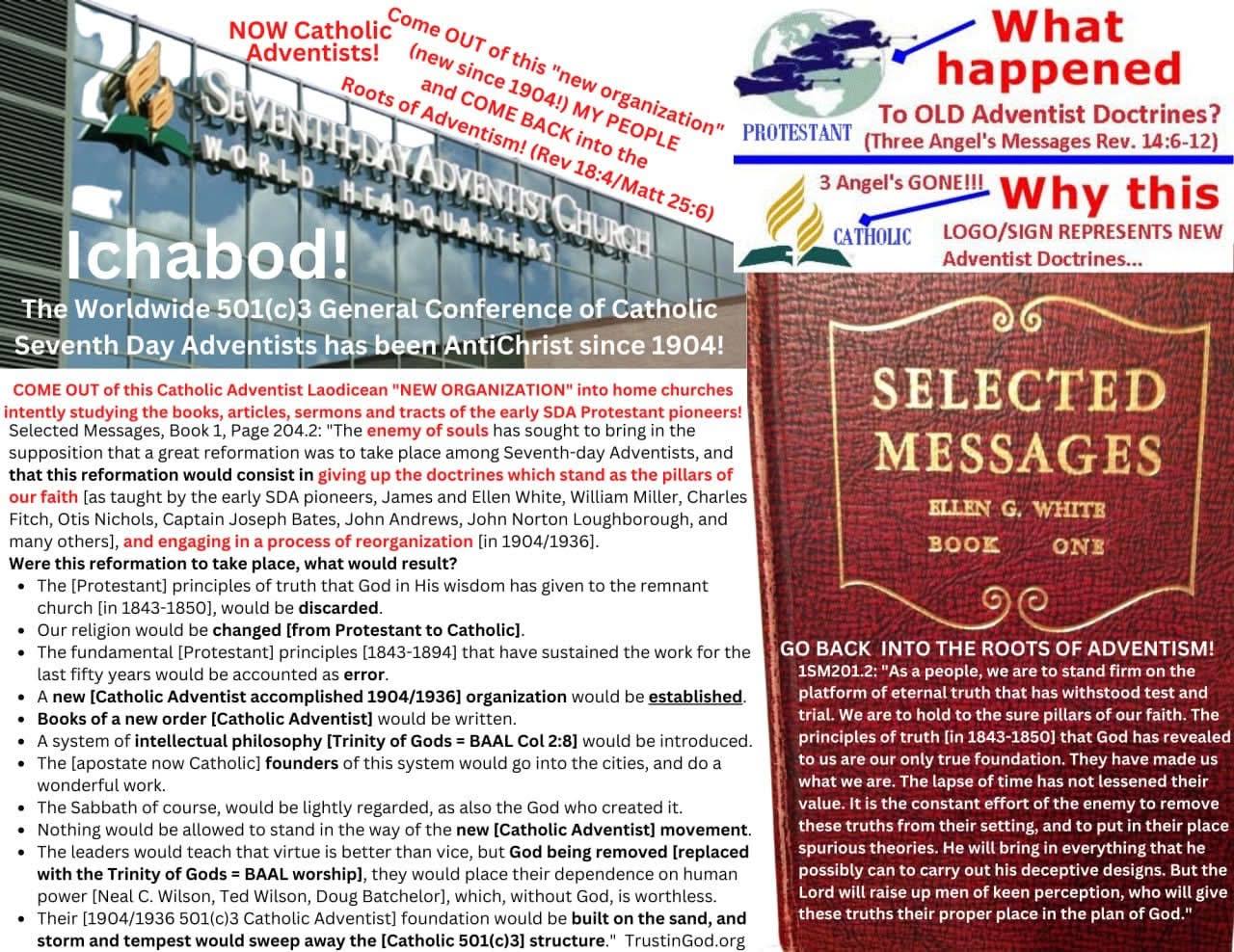
Open the study artwork, zoom from 1x to 10x, drag or scroll to inspect it, reset, and close. The original image is 1280 × 988 pixels; zoom does not add detail.Download the landmarks artwork
Read the underlying 1SM 201.2 paragraph, not only the artwork. The call is to preserve the revealed principles, not merely to admire a historical name.
Download the image, copy it where supported, or share its canonical study link.
The state of Laodicea is a warning, not a badge of safety
Revelation 3:17 describes a people who think they need nothing while Christ sees them as wretched, miserable, poor, blind, and naked. Self-deception, empty profession, resistance to correction, and an unprepared heart cannot be cured by claiming remnant status.
What Captain Joseph Bates wrote
“Jesus still loves some that are in the Laodicean church, and calls on them to repent.”
“Jesus will commune with you if you will open your heart and receive the truth.”
Joseph Bates, “The Laodicean Church,” Second Advent Review and Sabbath Herald, November 1850, pp. 7–8; article signed November 10, 1850. Read the complete article, especially p. 8.14.
Bates then applied Laodicea to Adventists who had retreated from the 1844 position, and Philadelphia to the shut-door believers. His historical application must not be silently rewritten as a statement about a corporation formed in 1904. His appeal remains searching: receive present truth and repent while Christ’s ministry continues.
Who says, “Laodicea, that’s us”?
“Today we hesitate to claim we’re the remnant; but as for Laodicea, that’s us! Us alone!”
Roy Adams, “Thinking Aloud About Laodicea,” Adventist Review, August 28, 2008, p. 5.
Adams describes a familiar Adventist self-identification, then questions its exclusiveness: he proposes that the warning applies more widely, asks whether Laodicea can change, and urges humility. This is not a declaration that every Adventist is irredeemably rejected. Read his entire editorial below. The local file is the complete 28-page issue, opened at scan 5.
Page numbers count the PDF scans, including covers and preliminary leaves. Scroll to read and turn pages at the edge; drag to pan; use Ctrl+scroll to zoom. Recenter restores the fitted width.
25 searching warnings — let the testimony reach your own heart
These are Ellen White’s words, not modern paraphrases in quotation marks. Bold emphasis is added; shorter extracts are identified. Follow each original-source link for its context. Read Revelation 3:14–22 and Matthew 25:1–13 alongside them.
The sanctuary’s judgment measures character, not publicity. Manuscript 92a, 1898, also cautions that we cannot read hearts and sort individual people into wise and foolish. Apply the testimony personally rather than using it to oppress others.
1. The foolish-virgin condition is the Laodicean state
“The state of the Church represented by the foolish virgins, is also spoken of as the Laodicean state.”
Ellen G. White, The Review and Herald, August 19, 1890, paragraph 10.
Type a word or several nearby keywords. Select passages to copy or share with their source, direct reading link, preview artwork, and invitation to revive the Advent pioneer books.
Share selected by email or social network
Enter keywords to find and share passages.
Apostasy is departure from the truth — compare the documents
SundayLaw.com’s position is that replacing the pioneer foundation is apostasy, not progress. Test changes in teaching and practice against the original messages. A corporation, a familiar name, a majority vote, or a shortened book does not establish fidelity to Christ.
The enemy of souls has sought to bring in the supposition that a great reformation was to take place among Seventh-day Adventists, and that this reformation would consist in giving up the doctrines which stand as the pillars of our faith, and engaging in a process of reorganization. Were this reformation to take place, what would result? The principles of truth that God in His wisdom has given to the remnant church, would be discarded. Our religion would be changed. The fundamental principles that have sustained the work for the last fifty years would be accounted as error. A new organization would be established. Books of a new order would be written. A system of intellectual philosophy would be introduced. The founders of this system would go into the cities, and do a wonderful work. The Sabbath of course, would be lightly regarded, as also the God who created it. Nothing would be allowed to stand in the way of the new movement. The leaders would teach that virtue is better than vice, but God being removed, they would place their dependence on human power, which, without God, is worthless. Their foundation would be built on the sand, and storm and tempest would sweep away the structure.
The vision’s immediate warning concerns denying God’s leading in the Advent movement. Begin with the path narrative and the early writings, then examine later claims against them.
1904: a name is not proof of continuity
The pioneer name adopted in 1860 and the corporate title associated with April 15, 1904, are not identical titles. The five-signers study argues that the similar name conceals a spiritual departure. That is the site’s historical/theological argument.
Idem sonans concerns similar-sounding names in legal contexts; resemblance alone does not prove deliberate identity theft or determine trademark rights. Examine the documents rather than treating the doctrine’s name as proof of criminal intent.
The 1904 study collects claims about Catholic parallels. The primary Adventist Review column is dated March 5, 1981, p. 3, not March 3. In a discussion of ASI, international cooperation, and a United Nations guest, Wilson used “catholic” in its universal sense. That wording by itself is not an admission of Roman Catholic membership.
The separate “historical trash heap” statement is circulated as material from the Pacific Press litigation. Without the original filing here, it is not presented as verified personal sworn testimony. Distinguish legal advocacy, a printed column, and theological interpretation.
The Great Hope: retaining fragments does not preserve the full warning
The eleven-chapter adapted edition cuts down the historical and prophetic case. Keeping a few references is not the same as giving readers the complete warning. It retains mentions of the papacy, the papal change of the Sabbath, and the beast. The accurate charge is not that every reference disappeared, but that the full treatment is not reproduced in this booklet.
The footnotes make the omission visible. On PDF scan 58, “Our Only Safeguard”, the mark-of-the-beast discussion sends readers to The Great Controversy, chapter 38. On PDF scan 64, “In Defense of the Truth”, the papal change of the Sabbath sends them to chapter 3. These are page footnotes, not an appendix that restores the missing chapters.
Give people the message—not a shortened substitute that leaves them needing another book for the fuller warning. If the adaptation is used as an introduction, put the complete work in their hands too.
Identify the edition before making the claim. The White Estate also hosts a distinct, 719-scan PDF titled The Great Hope with the full-length 42-chapter sequence, including “An Era of Spiritual Darkness,” “God’s Law Immutable,” and “The Final Warning.” The criticism here concerns the eleven-chapter adapted edition, not every file bearing the title and not every edition of The Great Controversy.
The midnight cry joined the second message — the loud cry joins the third
“The message of the fall of Babylon, as given by the second angel, is repeated, with the additional mention of the corruptions which have been entering the churches since 1844.”
“This message seemed to be an addition to the third message, joining it as the midnight cry joined the second angel’s message in 1844. The glory of God rested upon the patient, waiting saints, and they fearlessly gave the last solemn warning, proclaiming the fall of Babylon and calling upon God’s people to come out of her that they might escape her fearful doom.”
Ellen G. White, Early Writings, p. 277.2; excerpt with the intervening sentence retained. Read the complete paragraph.
The call is not to make peace with the corruptions. It is to expose them, repeat the warning, and call God’s people out. The light behind the Advent band must not be denied in the name of a newer organization or a more acceptable message.
Repeat the message. Receive the correction. Open the door.
The second angel’s call out of Babylon must not be replaced with institutional self-congratulation. The loud cry and the straight testimony call for repentance, obedience, and the righteousness of Christ—not a proud claim to possess a label while resisting the truth.
Early Writings, pp. 270–271, connects the shaking with the True Witness’s counsel and the powerful witness with the latter rain and loud cry. In Manuscript 92a, 1898, paragraph 11, Ellen White says the three angels’ messages will be repeated. Repeat their substance, not merely their names.
The warning ends with an invitation, not despair. Revelation 3:19–20 calls those Christ loves to repent and open the door. The Laodicean message can still be received now; the foolish virgins’ closed door warns against postponing preparation until it is too late. Do not confuse an opportunity to repent with a guarantee that delay is safe.